
Welcome to Canterbury Astronomical Society › Forums › Canterbury Astronomical Society Forums › Astronomy (Public Forum) › Supernova SN 2021ads in NGC 5215
- This topic has 0 replies, 1 voice, and was last updated 5 years, 6 months ago by
 Cameron McEwing.

- AuthorPosts
- March 3, 2021 at 11:36 pm - Views: 110 #3270
 Cameron McEwingParticipant
Hi All
I’m not sure if this is of interest to anyone here, but I thought I would share it just in case.
I’ve been tracking a recent supernova (Jan 13) in NGC 5215. The supernova is a Type Ia supernova and can be used as a standard candle to measure the distance to its parent galaxy.
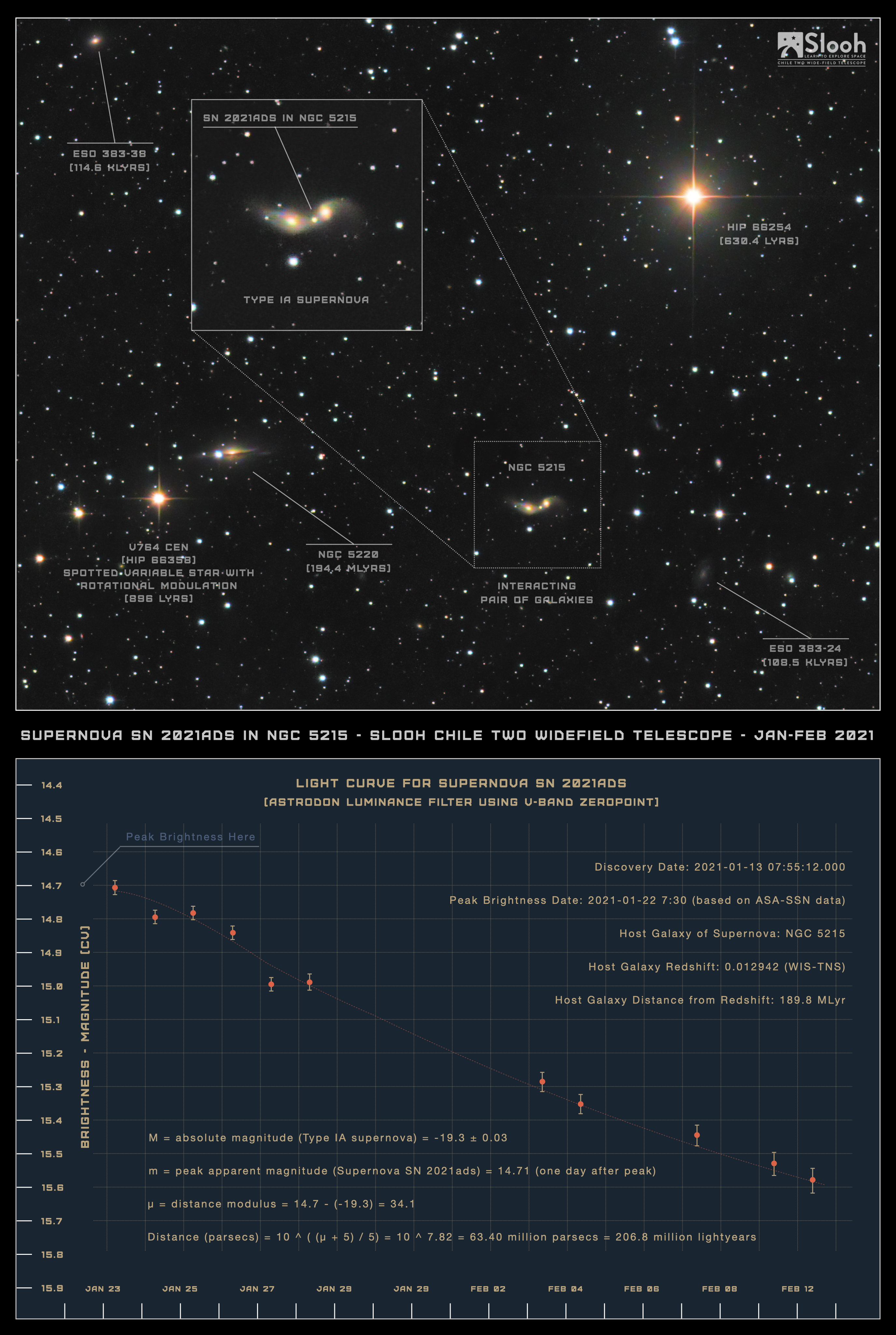
I’ve been collecting data using telescopes at Slooh.com, and then doing photometry to measure the supernova’s brightness using the AAVSO VPhot tool. I created this poster of the results…

Here is the text that accompanied the poster…
There is a lot going on in this poster, but center stage is the supernova SN 2021ads. SN 2021ads is a Type Ia supernova. This supernova was only discovered a month and half ago, even though its light started its journey towards us when the dinosaurs walked the Earth during the Jurassic.
SN 2021ads appears to have detonated in the bridge of matter connecting the nuclei of a pair of interacting galaxies. This makes for a spectacular sight, with the incandescent supernova outshining the pair of galactic nuclei that sandwich it.
The release of energy from SN 2021ads is absolutely stunning. This single dying star for this brief moment in time is more luminous than the billions of stars that compose the pair of interacting galaxies that birthed it. It shines with a brightness around 4 billion times that of our own Sun.
Type Ia supernovae, like SN 2021ads, occur in binary star systems where one or both of the progenitor stars are a white dwarf star. A unique feature of Type Ia supernovae is that they glow with an almost constant brightness at their peak, independent of the mass or composition of the progenitor star, or the process of ignition. This makes them ideal for use as standard candles for measuring cosmic distances.
A standard candle is an object of known brightness. If you know the brightness of an object at a known distance from the object, and if you know its apparent brightness as observed from Earth, you can work out how far away it is. This is possible because there is a simple relationship between apparent brightness and distance for an object of known brightness.
In the graph in the attached poster, I have used this relationship to estimate the distance to SN 2021ads. The calculated distance of 206.8 million lightyears is very close to the distance estimate obtained from the cosmological redshift of SN2021ads’ parent galaxy which is 189.8 million lightyears.
You do not need to understand the math to appreciate how cool this is. Simply by measuring the brightness of a Type Ia supernova at its peak, you can measure the distance to its parent galaxy by using a very simple piece of math. That it is even possible to measure the distance to an object 200 million years away traveling at the speed of light, blows my mind.
Cameron 🙂
- AuthorPosts
- You must be logged in to reply to this topic.