
Welcome to Canterbury Astronomical Society › Forums › Canterbury Astronomical Society Forums › CAS Members › James Webb Space Telescope
Tagged: Jwst
- This topic has 1 reply, 2 voices, and was last updated 4 years, 9 months ago by
 Rob Glassey.

- AuthorPosts
- January 4, 2022 at 10:27 am - Views: 115 #3948
 Marc BunyanParticipant
Was just wondering if anyone has had a chance to get any images of the JWST as it heads towards L2? With the sunshield now fully deployed (not taught yet) it should be visible almost permanently 🙂
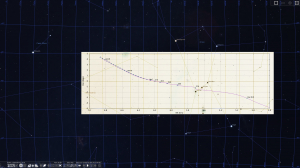
Found this upside down plot…

-
This topic was modified 4 years, 9 months ago by Marc Bunyan.
January 4, 2022 at 5:01 pm - Views: 361 #3952Rob GlasseyModeratorHi Marc,
I’ll carry on this thread sine your image work in this one 🙂
YES!
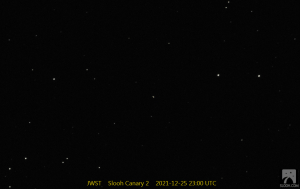
Although I’ve been away and haven’t had a chance to use my own gear yet, I have been using Slooh.com, and I have captured it, and the Ariane booster stage, may times.
Below is an animated GIF. Hopefully it works!
Captured just 10 hours and 40 minutes after launch, already 124,000 km from Earth, about 1/3 of the distance to the moon. Magnitude 13.

It got fainter as it got further away, then got a magnitude brighter when the sunshield booms were folded out (sunshiled not deployed), then it seems to be another magnitude brighter after the sunsheild was fully extended.
My latest images from 3:40pm NZDT today (4th) measures JWST as mag 15.4 and the booster as 16.9. Both within most imaging setups.
In those images JWST was 855,ooo km away, and booster was 964,000 km away. Maximum motion is about 4″/minute near transit (mostly due to paralax and earth rotation). ie, it will only trail 4 arc seconds in a 1 minute integration. It should be quite obvious in 1 minute. Blinking images 10-30 minutes apart will clearly show the movement.
Based on this and it’s final orbit, we should be able to image JWST every clear night throughout it’s operational life.
To locate it you can use this page:
https://projectpluto.com/sat_eph.htm
These ephemeris are based on the most recent actual observations by experianced amateurs who normally track near earth asteroids.
Other sources are:
https://ssd.jpl.nasa.gov/horizons/app.html#/
https://unistellaroptics.com/observe-jwst/
I believe the unistellar site uses JPL data, but is easier to use.
JPL was last updated 31st Dec, but the data is still pretty close, after all they are the guys flying it!
In any case none of these will be more than an arc minute or two out, so well within most camera fields.
The booster is only being tracked by project pluto and the MPML group: https://groups.io/g/mpml
-
This topic was modified 4 years, 9 months ago by
- AuthorPosts
- You must be logged in to reply to this topic.