
Welcome to Canterbury Astronomical Society › Forums › Canterbury Astronomical Society Forums › CAS Members › Summer Nights Charts
- This topic has 3 replies, 1 voice, and was last updated 3 years, 7 months ago by
 Rob Glassey.

Viewing 4 posts - 1 through 4 (of 4 total)
- AuthorPosts
- February 21, 2023 at 10:47 pm - Views: 97 #4623
 Rob GlasseyModerator
Notes for Summer Nights charts
Orion
- Pleiades & Hyades
- M35 in Gemini, beside another small, dim cluster
- Orion’s belt cluster
- Orion Nebula M42, bright centre, outlying nebula visible on dark night
- M43 – part of same nebula divided off by dust lane
- Trapezium – tight quadruple star in heart of M42 – box shape
- NGC 1981 Open cluster
- Iota triple star – close double 2.7/7-11″, dim secondary, very dim third star further way in arc, mag 9.7-49”
- Same field as Iota, bright wide pair HIP 26197 & 99 4.8/5.6-32”
- Sigma quadruple – easy triple in line 3.7/6.6/6.3-13″/41″, dim fourth star close on opposite side 8.8-11”
- Mintaka 2.2/6.8-53″ wide but dim secondary
- Rigel 0.3/6.8-9.3″ close, difficult, much dimmer secondary
- Lambda 3.5/5.4-4.1” – very close, dimmer secondary, amongst large loose cluster of stars.
Double star notation: 3.5/6.1-100″ >> Stars are magnitude 3.5 and 6.1, separated by 100 arc seconds
Lepus
- Very wide bino double Gamma Lepus – 3.5/6.1-100”, unrelated stars.
- Wide double HIP 25397 in centre of Lepus, 5.8/7.5-26”
- M79 globular cluster, dim and fuzzy in small scope brighter concentrated centre.
Canis Major & Puppis
- M41 Open cluster – big, bright, many stars
- Tau Canis Major cluster – Just a bright star at first glance, but averted vision makes many stars appear!
- 145 CMa – colourful wide double 5/5.8-26″ Orange/Blue
- k-Puppis – Evenly matched close but easy “cat eyes” pair 4.4/4.6-10″
- M93 – rich small open cluster, many tiny stars and haze
- c-Puppis – Bright red star in big bright cluster NGC2451
- b-Puppis – near the dimmer cluster NGC2477 with hundreds of tiny stars and haze
- M47 big and bright, scattered stars
- M46 hundreds of dimmer stars – nice on a dark night
- 2 Puppis, easy double 6/6.8-17″
- M50 & M48, good open clusters, many stars
Monoceros
- Beta Monoceros triple. First 2 stars are a close double 4.6/5-7.2″. Secondary of these is very close double 5.0/5.3-2.9″
Need highest power and a very steady night to split secondary. A fourth dimmer star is 250″ away. - NGC 2232 – Loose cluster near Beta Mon, resolves in binos
- More stars of NGC2232 visible in telescope, need wide field.
- M48 – big open cluster. Look for bright Procyon, then over to triangle of Zeta,27 and 28. Carry on to M48
- The Rosette nebula contains a small cluster of 6 bright stars. On a dark night the nebula itself might be visible in binos with averted vision.
- Christmas tree cluster, NCG2264, needs wide field but shows stars like lights on a cone shaped Christmas tree.
- Follow arc of stars from Xi Gemini to 15 Mon, 13Mon , and Epsilon Mon
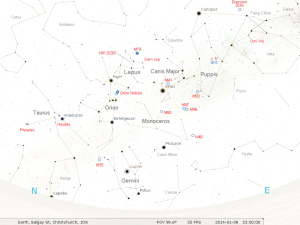
February 21, 2023 at 10:48 pm - Views: 210 #4624Rob GlasseyModeratorSummer Milky Way chart – click to enlarge
 February 21, 2023 at 10:49 pm - Views: 205 #4625Rob GlasseyModerator
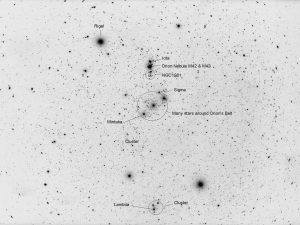
Orion Chart
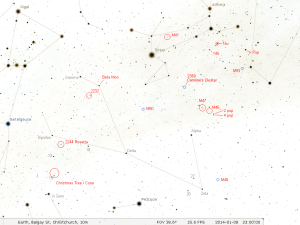
February 21, 2023 at 10:51 pm - Views: 222 #4626Rob GlasseyModeratorCanis Major, Puppis & Monoceros charts
- AuthorPosts
Viewing 4 posts - 1 through 4 (of 4 total)
- You must be logged in to reply to this topic.
Rob Glassey